







🔥♟️VOTE ON OUR NEXT DROP! ♟️🔥
Control The Center
Menu
SPECIAL RULE intermediate

En Passant

A special capture rule allowing pawns to take an adjacent enemy pawn that just leaped two squares forward.

⚡ Rule at a Glance (TL;DR)

  • En Passant ('in passing') is a special pawn-capturing rule in chess.
  • It only applies when an opponent advances a pawn TWO squares from its starting square, landing directly adjacent to your pawn.
  • You can capture their pawn diagonally behind it as if it had only moved one square.
  • CRITICAL: En passant is only legal on the IMMEDIATE NEXT TURN. If you make any other move, you forfeit the right forever for that pawn.

Interactive Rule Board

3 Interactive Modes
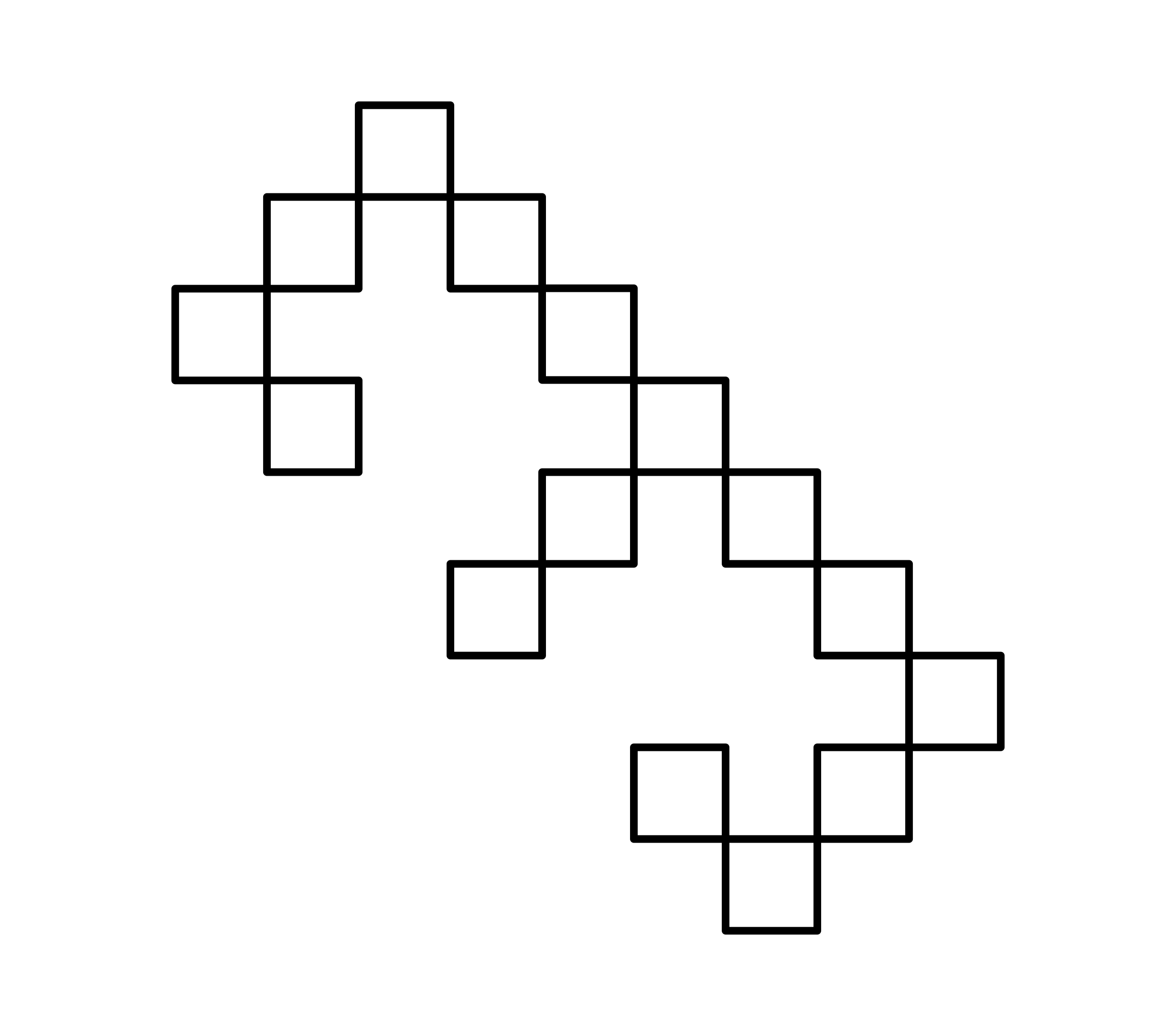
Board configuration diagram for En Passant

Starting Position (FEN): 4k3/8/8/3pP3/8/8/8/4K3 w - d6 0 2

Highlighted Squares: d6

📋 Essential Conditions

  • Your pawn must be on the 5th rank (for White) or 4th rank (for Black).
  • The enemy pawn must make an initial two-square push to land horizontally adjacent to your pawn.
  • You must make the en passant capture on the very next turn; the right expires immediately if skipped.

⚠️ Common Mistakes

  • Waiting one turn before trying to capture en passant (the rule is 'use it or lose it immediately').
  • Attempting en passant with a piece other than a pawn (only pawns can perform or be captured by en passant).
  • Attempting en passant against a pawn that reached your side via two individual 1-square steps.

“En passant” (a French term meaning “in passing”) is one of the most misunderstood and frequently questioned rules in chess. It is a special pawn-capturing mechanic that prevents players from using the two-square initial pawn push to sneak past an enemy pawn unharmed.

If your opponent moves a pawn two squares forward from its starting rank and lands directly beside your pawn, you have the right for one move only to capture that pawn diagonally behind it—as if it had only moved a single square forward.

It is the only move in chess where the capturing piece does not land on the exact square of the piece it removes.


The 3 Exact Conditions Required for En Passant

To legally execute an en passant capture, all three of the following conditions must be satisfied:

  1. Your Pawn Must Be on the 5th Rank (or 4th rank if you are Black): Your attacking pawn has advanced deep into enemy territory (e.g., White pawn on e5 or Black pawn on d4).
  2. Enemy Pawn Does a 2-Square Leap: The opponent pushes an adjacent pawn two squares forward from its starting square (e.g., Black plays d7-d5), landing horizontally beside your pawn.
  3. Immediate Execution (“Use It or Lose It”): You must capture en passant on the very next turn. If you make any other move anywhere on the board, your right to capture that specific pawn en passant is permanently forfeited.

Step-by-Step Move Anatomy

1. Initial State    : White pawn on e5. Black pawn on d7.
2. Opponent Move    : Black plays d7-d5 (landing directly next to White's e5 pawn).
3. En Passant Move  : White moves pawn from e5 to d6 (exd6).
4. Board Result     : White pawn lands on d6; Black pawn on d5 is captured and removed!
For experienced players

When recording en passant in standard algebraic notation, write it as a regular pawn capture with the destination square: exd6 (optionally appended with e.p. in older literature, though modern FIDE notation simply uses exd6).

See also:How the Pawn Moves·Pawn Promotion·Castling
Frequently Asked Questions

When is en passant legal in chess?

En passant is legal when: 1) Your pawn is on its 5th rank (for White) or 4th rank (for Black), 2) An enemy pawn pushes 2 squares from its starting rank to land beside your pawn, and 3) You execute the capture on the very next turn.

Can en passant be played on any turn after the pawn push?

No. En passant must be played immediately on the turn following the two-square pawn advance. If you make any other move on the board, the right to capture that pawn en passant is permanently lost.

Why was the en passant rule created?

In the 15th century, the two-square initial pawn push was introduced to speed up the opening phase of chess. En passant was added simultaneously to prevent pawns from abusing the two-square jump to sneak past enemy pawns without risking capture.