
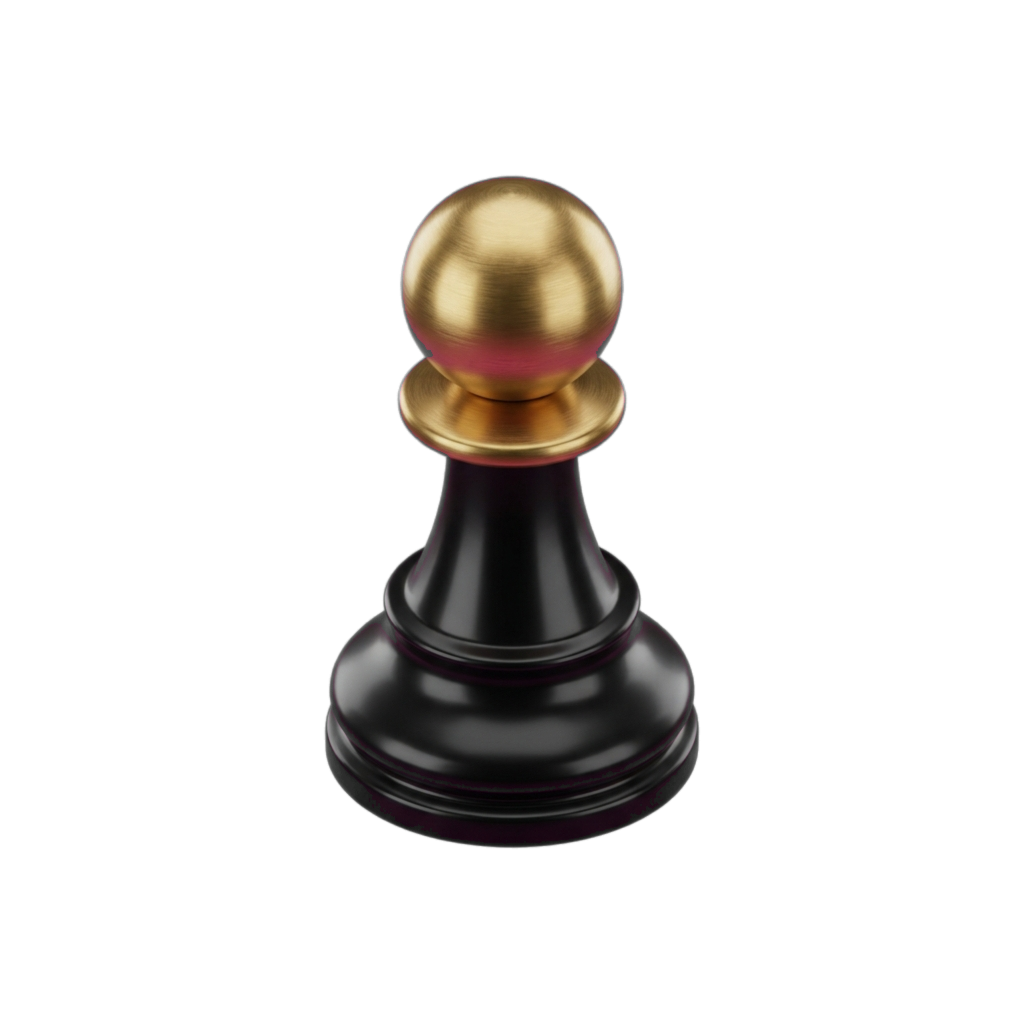


Pawns are the foot soldiers of chess. Although they are the lowest-value piece on the board (valued at 1 point), pawn structure forms the backbone of all chess strategy. As the legendary 18th-century master François-André Danican Philidor famously stated: “Pawns are the soul of chess.”
Pawns have unique movement and capture mechanics distinct from every other piece on the board.
3 Core Pawn Movement Rules
1. Standard Advance  : Moves 1 square straight forward into an empty square.
2. Initial Leap      : Has the option to jump 2 squares forward on its FIRST move.
3. Diagonal Capture  : Captures enemy pieces 1 square diagonally forward.
Pawns cannot move or capture backward. Once a pawn advances, the squares it left behind can never be protected by that pawn again.
Blocked Pawns: The Straight-Ahead Gridlock
If an enemy or friendly piece sits directly on the square in front of your pawn, the pawn is blocked. It cannot jump over the obstacle and cannot capture straight ahead. The pawn remains immobilized until:
- The piece in front moves away, or
- An enemy piece lands diagonally in front, allowing a diagonal capture escape.
Special Pawn Superpowers
Pawns possess two exclusive game-altering mechanics that no other pieces have:
- En Passant: The special right to capture an enemy pawn that just leaped two squares forward past your rank.
- Pawn Promotion: Reaching the opposite end of the board transforms the humble pawn into a Queen, Rook, Bishop, or Knight.
For experienced players
Because pawns cannot move backward, every pawn advance permanently weakens the squares adjacent to it. Master players carefully calculate pawn pushes before committing them.
See also:En Passant·Pawn Promotion·Board Setup