












🔥♟️VOTE ON OUR NEXT DROP! ♟️🔥
Control The Center
Menu
1.d4 advanced critical For black
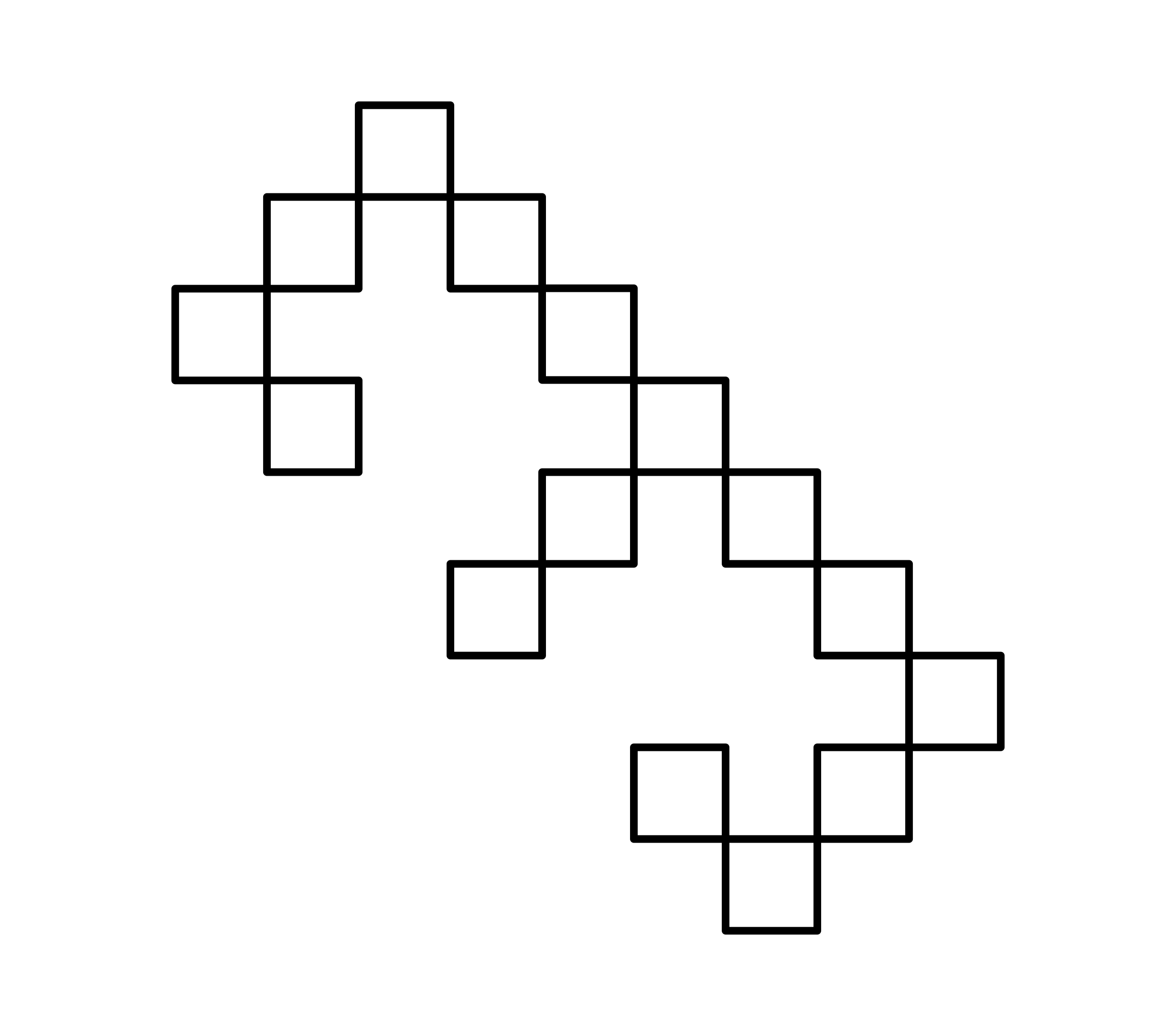
Nimzo-Indian Defense signature position rendered as generative art
🔥♟️Vote on our next Drop! ♟️🔥

E20–E59

Nimzo-Indian Defense

Hypermodern brilliance: pinning the knight to inflict structural weaknesses on White's queenside.

TLDR

  • • Pins White's c3 knight with 3...Bb4 to fight for the central e4 square without committing central pawns early.
  • • Often gives up the bishop pair (Bxc3) in exchange for saddling White with doubled, isolated c-pawns.
  • • Highly flexible for Black with classical setups (d5/c5) or hypermodern flank structures (b6/Ba6).
  • • The cornerstone defense of World Champions from Capablanca and Botvinnik to Kasparov and Carlsen.

Opening

Nimzo-Indian Defense

Hypermodern brilliance: pinning the knight to inflict structural weaknesses on White's queenside.

Starting position

Starting Position

White opens with the queen's pawn, seeking solid central authority.

Tip: use and to navigate

Move sequences and interactive tour paths for Nimzo-Indian Defense

Classical & Rubinstein Lines

  • Starting Position - White opens with the queen's pawn, seeking solid central authority.
  • 1. d4: Queen's Pawn Opening - White claims d4, establishing central presence.
  • 1... Nf6: Indian Defense - Black prevents White from immediately occupying e4 with a pawn.
  • 2. c4: Queen's Flank Claim - White claims queenside space and controls the d5 square.
  • 2... e6: Flexible Pawn Shield - Black prepares king-side development and clears the diagonal for the dark-squared bishop.
  • 3. Nc3: Threatening e4 - White intends to push e2-e4 to seize the entire center.
  • 3... Bb4: The Nimzo-Indian Pin - Black's hallmark move: pinning the knight to the king, eliminating White's control over e4.
  • 4. Qc2: The Classical Variation (Capablanca) - White defends c3 to avoid doubled pawns and fights for control of e4 with the queen.
  • 4... c5: Striking the Center - Black immediately challenges White's d4 anchor with flank pawn pressure.
  • 5. dxc5: Open Clashing Lines - White liquidates the central tension, leading to rich piece play.
  • 4. e3: The Rubinstein System - A rock-solid choice: White develops calmly, reinforcing d4 while preparing Nf3 and Bd3.
  • 4... O-O: King Safety First - Black castles immediately, ready to strike in the center with ...d5 or ...c5.
  • 5. Bd3: Aiming at the Kingside - White develops the bishop aggressively toward h7, setting up a rich strategic middlegame.

The Nimzo-Indian Defense is one of the most respected, theoretically sound, and deeply strategic chess openings ever devised. Formulated in the early 20th century by hypermodern pioneer Aron Nimzowitsch, the opening revolutionized chess philosophy by proving that Black does not need to occupy the center with pawns on move one to control it.

By pinning White’s knight on c3 with `3…Bb4`, Black directly prevents White from playing `4.e4`. If White later plays `a3`, Black frequently exchanges the bishop for the knight (`…Bxc3+`), saddling White with doubled, immobile c-pawns (`c3` and `c4`) that become long-term strategic targets.


🎯 Strategic Pillars of the Nimzo-Indian

  1. Denial of the e4 Square: Black’s bishop pin neutralizes the c3 knight, preventing White from constructing a classical pawn duo on e4 and d4.
  2. Dynamic Bishop Trade: Black often trades the dark-squared bishop for White’s knight. In exchange, White receives the bishop pair, while Black gains a superior pawn structure by targeting White’s doubled c-pawns.
  3. Flexible Central Blockade: Black can play either `…c5` (striking at d4) or `…d5` (establishing a solid classical stake), frequently anchoring a knight on `e4` or `c5`.
  4. Counterplay on Light Squares: With White’s light-squared pawn on c4, Black often fianchettoes the queen’s bishop with `…b6` and `…Ba6` to relentlessly pressure the weakened c4 outpost.

♟️ Main Line Variations

1. The Classical Variation (`4.Qc2`)

Named after World Champion José Raúl Capablanca, White covers c3 with the queen to avoid doubled pawns while retaining the bishop pair. Black responds energetically with `4…O-O`, `4…c5`, or `4…d5`.

2. The Rubinstein Variation (`4.e3`)

The most durable and classical system for White. White solidifies the d4 pawn, develops pieces naturally with `Bd3` and `Nf3`, and accepts a slow, maneuvering middlegame.

3. The Sämisch Variation (`4.a3`)

White immediately challenges the bishop with `4.a3 Bxc3+ 5.bxc3`. White accepts doubled pawns immediately in exchange for the bishop pair and an aggressive central pawn mass.


For experienced players

Garry Kasparov used the Nimzo-Indian and Queen’s Indian interchangeably throughout his World Championship matches with Anatoly Karpov, demonstrating that Black can achieve complete positional equality against 1.d4 with precise calculation.

See also:King's Indian Defense·Queen's Gambit·Catalan Opening·Pin·Pawn Structure·Controlling the center

Frequently Asked Questions (Nimzo-Indian Defense)

Why is the Nimzo-Indian considered one of the most reliable defenses to 1.d4?

The Nimzo-Indian immediately challenges White's ideal central expansion (preventing 4.e4) while maintaining maximum structural flexibility and dynamic counter-attacking potential.

Why does Black often trade the dark-squared bishop on c3?

Black willingly trades the bishop pair because doubling White's c-pawns (c3 and c4) creates permanent structural static targets that Black can blockade and siege with pawns on c5 and knights on a5 and c6.

What are the main systems White plays against the Nimzo-Indian?

The primary responses are the Classical Variation (4.Qc2 avoiding doubled pawns), the Rubinstein System (4.e3 solidifying the center), the Sämisch (4.a3 forcing an immediate bishop trade), and the Kasparov/Leningrad Variation (4.Nf3 and 4.Bg5).

How does the Nimzo-Indian differ from the Queen's Indian Defense?

The Nimzo-Indian occurs when White develops 3.Nc3 (allowing 3...Bb4 pin). If White avoids the pin with 3.Nf3, Black cannot play the Nimzo and typically transitions into the Queen's Indian with 3...b6 or Bogo-Indian with 3...Bb4+.

Famous Games

José Raúl Capablanca vs Max Euwe

AVRO, 1938

A textbook masterclass in blockading doubled c-pawns and converting spatial pressure into an endgame victory.

PGN Game Record for José Raúl Capablanca vs Max Euwe
[Event "AVRO"]
[Site "Netherlands"]
[Date "1938.11.06"]
[Round "1"]
[White "Capablanca, Jose Raul"]
[Black "Euwe, Max"]
[Result "1-0"]

1. d4 Nf6 2. c4 e6 3. Nc3 Bb4 4. Qc2 d5 5. cxd5 exd5 6. Bg5 h6 7. Bxf6 Qxf6 8. a3 Bxc3+ 9. Qxc3 O-O 10. e3 c6 11. Nf3 Bf5 12. Be2 Nd7 13. O-O Qe7 14. Nd2 Nf6 15. b4 a6 16. a4 Rfc8 17. Rfc1 Ne4 18. Nxe4 Bxe4 19. Bf1 Bf5 20. Qb2 Bd7 21. Rc5 b6 22. Rc3 a5 23. bxa5 bxa5 24. Rc5 Rcb8 25. Qc3 Qd8 26. Bd3 Rb4 27. Bc2 Rab8 28. h3 g6 29. Re1 Qg5 30. Kh2 Qf6 31. Re2 Qd8 32. Kg1 Qg5 33. f4 Qd8 34. Qe1 Kg7 35. Kh2 h5 36. Rf2 f5 37. Rf3 h4 38. g3 hxg3+ 39. Rxg3 Kf7 40. Qg1 Qf6 41. Rxa5 Rb2 42. Rg2 Rh8 43. Ra7 Ke7 44. Rg3 Qh4 45. Qg2 Kd8 46. Ra8+ Bc8 47. a5 Kc7 48. a6 Ra2 49. a7 Kb7 50. Rb8+ Kxa7 51. Rb1 Ba6 52. Rxg6 Rb8 53. Rg7+ Ka8 54. Rxb8+ Kxb8 55. Rg8+ Bc8 56. Qd2 1-0
♟️ Google Preferred Source

Follow Nimzo-Indian Defense & Opening Theory on Google

Add Control The Center as a preferred source on Google to see our interactive opening guides, Stockfish analysis, and tactical puzzles highlighted in Google Search.