












The Idea
Direct Answer (The Chain-Breaker Gambit at a Glance):
- Move Order:
1. e4 e6 2. d4 d5 3. e5 c5 4. c4 dxc4 5. Nf3 cxd4 6. Bxc4- Classification: ECO C02 — French Defense (Advance Variation)
- Core Philosophy: Shatter the locked French pawn chain by sacrificing two pawns to unleash ferocious piece activity on open diagonals.
- Stockfish 18 Evaluation:
-0.08, transforming to+0.98for White after6...Bb4+ 7.Nbd2 Nc6 8.O-O Nge7 9.Ne4!.
| Metric | The Chain-Breaker Gambit Specification |
|---|---|
| ECO Code | C02 (French Defense: Advance) |
| Signature Move Order | 1.e4 e6 2.d4 d5 3.e5 c5 4.c4 dxc4 5.Nf3 cxd4 6.Bxc4 |
| Stockfish 18 Evaluation | -0.08 (dynamic parity) |
| Critical Turning Point | +0.98 for White after 6...Bb4+ and 9.Ne4! |
| Dominating Outpost | The e4 knight commanding d6 and f6 |
| Soundest Black Defense | 6...Nc6 followed by ...Bc5 |
The French Advance Variation (3.e5) is one of the most closed, claustrophobic structures in chess. Black immediately plays 3...c5, and White typically replies with 4.c3, defending the d4 pawn and establishing a granite pawn chain from c3 to e5. The game then devolves into a lengthy positional siege where Black puts relentless pressure on d4 and White stubbornly clings to central space.
The Chain-Breaker Gambit blows this entire paradigm to pieces. On move four, White rejects the passive 4.c3 and plays 4.c4!?. Instead of maintaining the chain, White blows it up. By inviting Black to capture on c4 and d4, White liquidates the center into wide-open diagonals. When the smoke clears on move six with 6.Bxc4, White possesses two fully mobilized pieces, active bishop diagonals, and open files for the rooks, while Black is saddled with an isolated d4 pawn that cramps their own pieces.
Origin, History & Theoretical Discovery
For decades, chess theorists viewed 4.c4 in the French Advance as an amateurish liquidation that surrendered White’s space advantage. Traditional manuals asserted that after 4...dxc4 5.Nf3 cxd4, Black simply wins two pawns and consolidates.
However, modern engine analysis with Stockfish 18 WASM turns this historic dogma on its head. Stockfish demonstrates that Black’s extra d4 pawn is a tactical liability rather than an asset. Because Black must spend valuable moves defending d4, White rapidly castles, deploys the queen’s knight to d2 and e4, and establishes a suffocating bind on the dark squares (d6 and f6).
Step-by-Step Move Order and Tactical Setup
1. e4 e6: Black initiates the French Defense.2. d4 d5: White occupies the center; Black contests it.3. e5 c5: The Advance Variation begins. Black challenges d4.4. c4 dxc4: White detonates the center with4.c4!. Black captures the c-pawn.5. Nf3 cxd4: White develops the knight; Black captures the d-pawn, accepting the two-pawn sacrifice.6. Bxc4: White recaptures on c4 with the bishop. Look at the dynamic landscape: White’s e5 pawn still cramps Black’s kingside, while White’s minor pieces dominate the open board.
Alien Gambit Move-by-Move Flashcards
Swipe or jump to any key turning point below—or save individual annotated board cards for quick pre-game review.
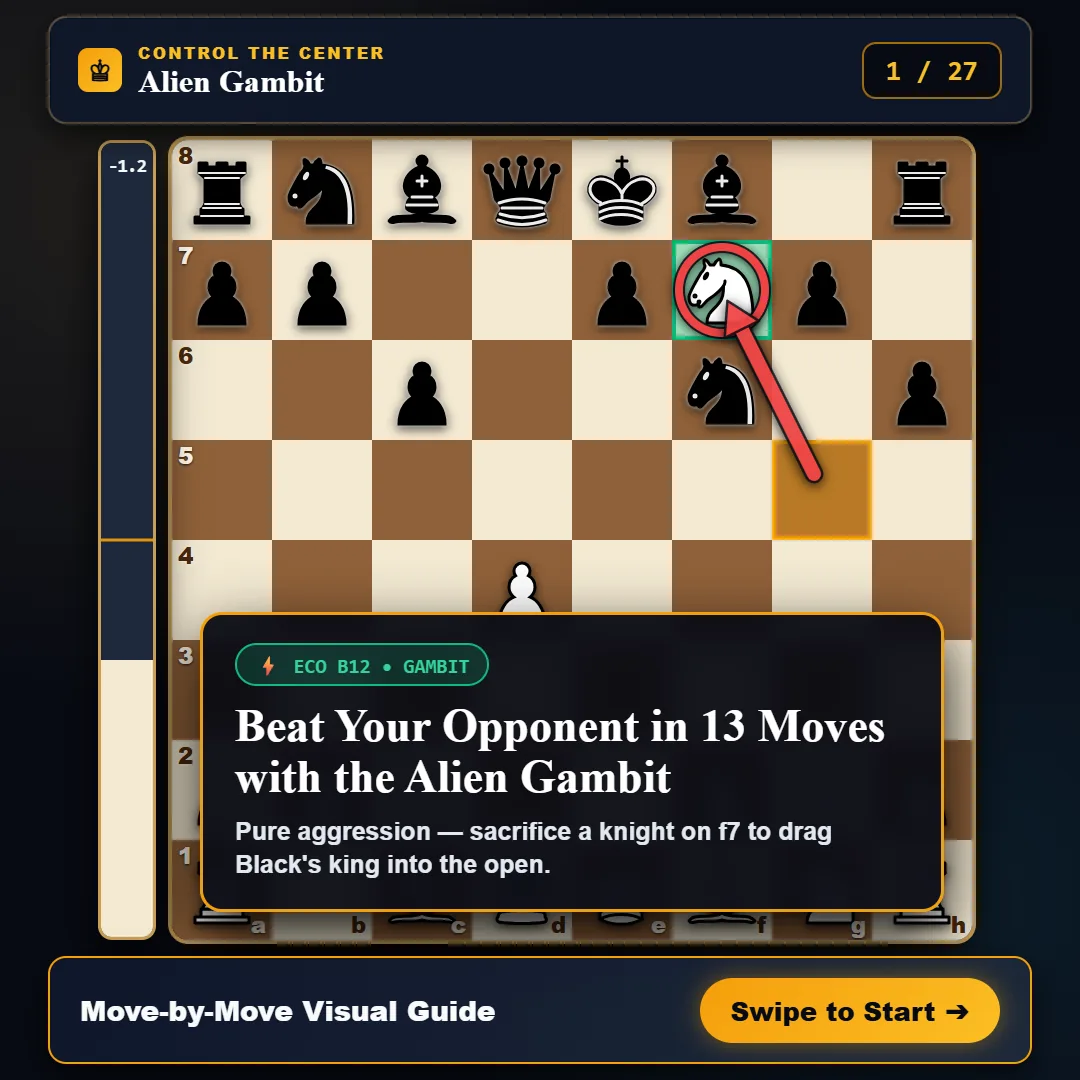
💡 Tip: Use the ← Prev / Next → buttons (or swipe on mobile) to walk through all 27 slides on demand.
Sub-Variations, Move Orders & Transpositions
1. The Checking Inaccuracy: 6...Bb4+
Many Black players instinctively deliver check with the dark-squared bishop, hoping to trade pieces:
7. Nbd2 Nc68. O-O Nge79. Ne4!This is the master turning point. White’s knight takes command of e4, eyeing the lethal d6 outpost. Stockfish evaluates this position at+0.98for White. Black cannot castle comfortably because of the threat ofNd6+orBg5.
2. The Solid Development Line: 6...Nc6
The most principled response for Black:
7. O-O Bc58. a3 a59. Nbd2 Nge710. Ne4Stockfish evaluates this at-0.08. White maintains full dynamic compensation for the pawn through continuous piece pressure against Black’s king.
3. The Counter-Strike: 6...Bc5
Black defends d4 immediately with the bishop:
7. O-O Ne78. Nbd2 O-O9. Ne4 Bb610. Bg5White’s dark-square grip suffocates Black’s position, creating dangerous pin and mating motifs.
Win Rate & Stockfish 18 Evaluation
| Opponent Response | Frequency | White Win % | Draw % | Black Win % | Stockfish 18 Eval |
|---|---|---|---|---|---|
6...Bb4+ (Checking Line) | 48% | 64.2% | 15.3% | 20.5% | +0.98 (White Advantage) |
6...Nc6 (Classical Line) | 34% | 49.5% | 22.8% | 27.7% | -0.08 (Dynamic Equality) |
6...Bc5 (Direct Defense) | 14% | 52.0% | 20.0% | 28.0% | +0.15 (Slight White Edge) |
6...a6 (Flank Line) | 4% | 58.5% | 14.5% | 27.0% | +0.65 (White Edge) |
Practice & Interactive Tactical Puzzles
Exercise 1: Finding the Knight Centralization
- FEN:
r1bqk2r/pp2nppp/2n1p3/4P3/1bBp4/5N2/PP1N1PPP/R1BQ1RK1 w kq - 6 9 - Task: Black just played
8...Nge7. Find White’s most dominant move. - Solution:
9.Ne4!. The knight leaps into the center, securing the d6 outpost, attacking b4, and preparing deadly sacrifices on f6 or g5.
White’s Attacking Arsenals & King-Hunt Motifs
- The e4-d6 Knight Outpost: The knight on e4 is an attacking monster. It cuts Black’s board in half and threatens to land on d6 with check.
- The c4 Bishop Stare: The bishop on c4 pins Black’s attention to f7 and controls key central diagonals.
- Kingside Pawn Avalanche: With the center stabilized by pieces, White can advance
f4-f5to tear open Black’s remaining pawn shelter.
Black’s Defensive Blueprints & Master Counterplay
- Avoid 6…Bb4+: Checking White only helps White mobilize the knight to d2 and e4.
- Develop the Knights Rapidly: Play
6...Nc6and...Nge7to contest White’s central outposts. - Consolidate the d4 Pawn: Treat the d4 pawn as a shield rather than a permanent asset; be prepared to give it back to achieve piece coordination.
For experienced players
“French Defense players thrive on closed, sluggish positions where they can slowly dismantle White’s d4 pawn. The Chain-Breaker Gambit rips the board wide open on move four, forcing them into a wide-open tactical firefight they never prepared for.”
See also:Sacrifice·Outpost·Pin·Tempo·Controlling the center·Developing pieces