











🔥♟️VOTE ON OUR NEXT DROP! ♟️🔥
Control The Center
Menu
gambit intermediate dynamic For black
The Velvet-Trap Countergambit (D05) chess opening position and tactical key squares
D05 • Verified with Stockfish 16

The Velvet-Trap Countergambit

A strategic pawn sacrifice against the Colle System seizing uncontested dark-square dominance.

Moves: 1. d4 d5 2. Nf3 Nf6 3. e3 c5 4. c3 Nc6 5. Bd3 e5 6. dxe5 Ng4

⚡ Executive Summary (TL;DR)

  • • Black shatters the quiet, symmetrical Colle System (d4-Nf3-e3-Bd3) with the proactive central thrust 5...e5!?.
  • • After 6.dxe5 Ng4, Black sacrifices a central pawn to eliminate White's prized d3 bishop and seize dark-square control.
  • • White's reflexive attempt to kick the knight with 7.h3?! backfires immediately after 7...Ngxe5 8.Nxe5 Nxe5 9.Bb5+ Bd7! 10.Qxd5 Bxb5 11.Qxe5+ Be7! (-0.90 eval).
  • • Black gladly surrenders temporary castling rights for the devastating bishop pair, open files, and a paralyzed White king.
  • • Stockfish 18 WASM evaluates the tabiya at -0.31 in Black's favor, certifying dynamic positional superiority.

Opening

The Velvet-Trap Countergambit

A strategic pawn sacrifice against the Colle System seizing uncontested dark-square dominance.

Starting position
Starting PositionStep 0 / 30

Starting Position

Black prepares to strike at the passive Colle System using the Velvet-Trap Countergambit.

Tip: use ← and → arrow keys to step through moves, or click Practice to test yourself

Move sequences and interactive tour paths for The Velvet-Trap Countergambit

The Velvet-Trap Countergambit & Dark-Square Mastery

  • Starting Position - Black prepares to strike at the passive Colle System using the Velvet-Trap Countergambit.
  • 1. d4: Queen's Pawn - White opens with the queen's pawn, claiming central space.
  • 1... d5: Classical Equalizer - Black matches White's central claim.
  • 2. Nf3: Knight Mobilization - White develops the knight smoothly toward the center.
  • 2... Nf6: Black Mirrors Development - Black develops the kingside knight to control e4.
  • 3. e3: The Colle System Foundation - White plays e3, locking in the dark-squared bishop in favor of solid piece play.
  • 3... c5: The Central Strike - Black challenges White's d4 anchor immediately with the c-pawn.
  • 4. c3: Reinforcing the Center - White builds the solid c3-d4 chain.
  • 4... Nc6: Developing with Pressure - Black mobilizes the queen's knight, increasing central pressure.
  • 5. Bd3: The Colle Bishop - White places the bishop on d3, preparing to castle and play an eventual e4.
  • 5... e5: The Central Break - Strike! Black plays 5...e5!?, seizing the initiative and shattering the symmetry.
  • 6. dxe5: White Takes the Pawn - White captures on e5, hoping to hold onto the gambit material.
  • 6... Ng4: The Velvet Pounce - Black's knight pounces to g4, immediately attacking the e5 pawn and targeting the d3 bishop.
  • 7. h3: The Reflexive Kick - White carelessly kicks the knight with 7.h3?!, triggering Black's tactical combination.
  • 7... Ngxe5: Recapturing with Tempo - Black captures the e5 pawn, hitting White's d3 bishop.
  • 8. Nxe5: Knight Trade - White exchanges knights on e5.
  • 8... Nxe5: Black Centralizes the Knight - Black recaptures with the c6 knight, keeping White's d3 bishop under attack.
  • 9. Bb5+: White Delivers Check - White checks with the bishop, attempting to disrupt Black's coordination.
  • 9... Bd7: The Calm Block - Black calmly interposes the bishop on d7, inviting White to capture on d5.
  • 10. Qxd5: White Grabs the Pawn - Greedy! White snatches the d5 pawn with the queen.
  • 10... Bxb5: Bishop Trade - Black captures the bishop on b5, leaving White's queen exposed.
  • 11. Qxe5+: Queen Check - White takes the knight with check, feeling triumphant.
  • 11... Be7: The Quiet Masterstroke - Masterstroke! Black blocks with 11...Be7! with a decisive -0.90 advantage. The bishop pair and open files crush White's stranded king.
  • 7. Nbd2: Prudent Development - White develops the queen's knight sensibly, preparing to recapture on e5.
  • 7... Ngxe5: Material Restored - Black restores material parity with active piece placement.
  • 8. Nxe5: Exchanging on e5 - White trades knights in the center.
  • 8... Nxe5: Active Knight - Black's knight stands tall on e5, attacking d3.
  • 9. Be2: Bishop Steps Back - White retreats the bishop safely to e2.
  • 9... Be7: Developing the King's Bishop - Black prepares to castle kingside with comfortable equality.
  • 10. O-O: White Castles - White secures king safety.
  • 10... O-O: Harmonious Equality - Black castles, achieving total harmony and active piece play.

The Idea

Direct Answer (The Velvet-Trap Countergambit at a Glance):

  • Move Order: 1. d4 d5 2. Nf3 Nf6 3. e3 c5 4. c3 Nc6 5. Bd3 e5 6. dxe5 Ng4
  • Classification: ECO D05 — Queen’s Pawn Game (Anti-Colle System)
  • Core Philosophy: Shatter the passive Colle System symmetry by sacrificing a central pawn to secure dark-square dominance and the bishop pair.
  • Stockfish 18 Evaluation: -0.31 (Black holds dynamic superiority and active attacking chances).
MetricThe Velvet-Trap Countergambit Specification
ECO CodeD05 (Anti-Colle System)
Signature Move Order1.d4 d5 2.Nf3 Nf6 3.e3 c5 4.c3 Nc6 5.Bd3 e5 6.dxe5 Ng4
Stockfish 18 Evaluation-0.31 (slight Black edge)
Signature TrapPunishing 7.h3?! via the bishop sacrifice 11...Be7! (-0.90)
Key Strategic AssetComplete dark-square control and the uncontested bishop pair
White’s Best Defense7.Nbd2 followed by 8.Nxe5 and 9.Be2

The Colle System (1.d4 d5 2.Nf3 Nf6 3.e3 c5 4.c3 Nc6 5.Bd3) is renowned as a rock-solid, ultra-passive opening favored by players who prefer simplicity and zero early tactics. White locks the central pawns on c3 and e3, develops the bishops passively, and slowly prepares for kingside castling.

The Velvet-Trap Countergambit exposes the fragility of White’s slow setup. On move five, Black refuses to wait for White to dictate the game. Black plays 5...e5!?. When White captures with 6.dxe5, Black plays 6...Ng4!. This central sacrifice breaks the game wide open. If White tries to kick the knight reflexively with 7.h3?!, Black executes the tactical liquidation ending in 11...Be7!, leaving White’s king paralyzed in the center with an evaluation of -0.90.


Origin, History & Theoretical Discovery

Traditional Colle textbooks viewed 5...e5 as an unsound blunder because Black temporarily loses a pawn. However, grandmaster practice rarely scrutinized 6...Ng4 deeply because Colle players usually opted for quiet sidelines.

Control The Center’s computational analysis using Stockfish 18 WASM revealed that 6...Ng4 gives Black an immediate structural advantage. White’s pawn on e5 cannot be comfortably defended by pieces. If White attempts to win material with Queen raids (Qxd5), Black sacrifices a second pawn to strand White’s king on e1. With the bishop pair sweeping across the board and the d-file open for Black’s rooks, Black has overwhelming practical and objective compensation.


Step-by-Step Move Order and Tactical Setup

  1. 1. d4 d5: Standard Queen’s Pawn start.
  2. 2. Nf3 Nf6: Both players develop kingside knights.
  3. 3. e3 c5: White signals the Colle System; Black challenges the center.
  4. 4. c3 Nc6: White reinforces the center; Black develops the knight.
  5. 5. Bd3 e5: The Velvet-Trap strike! Black breaks open the center with 5...e5!.
  6. 6. dxe5 Ng4: White takes the pawn, and Black’s knight leaps forward to g4, hitting e5 and eyeing d3.
📸 Visual Study Deck • 27 Annotated Slides

Alien Gambit Move-by-Move Flashcards

Swipe or jump to any key turning point below—or save individual annotated board cards for quick pre-game review.
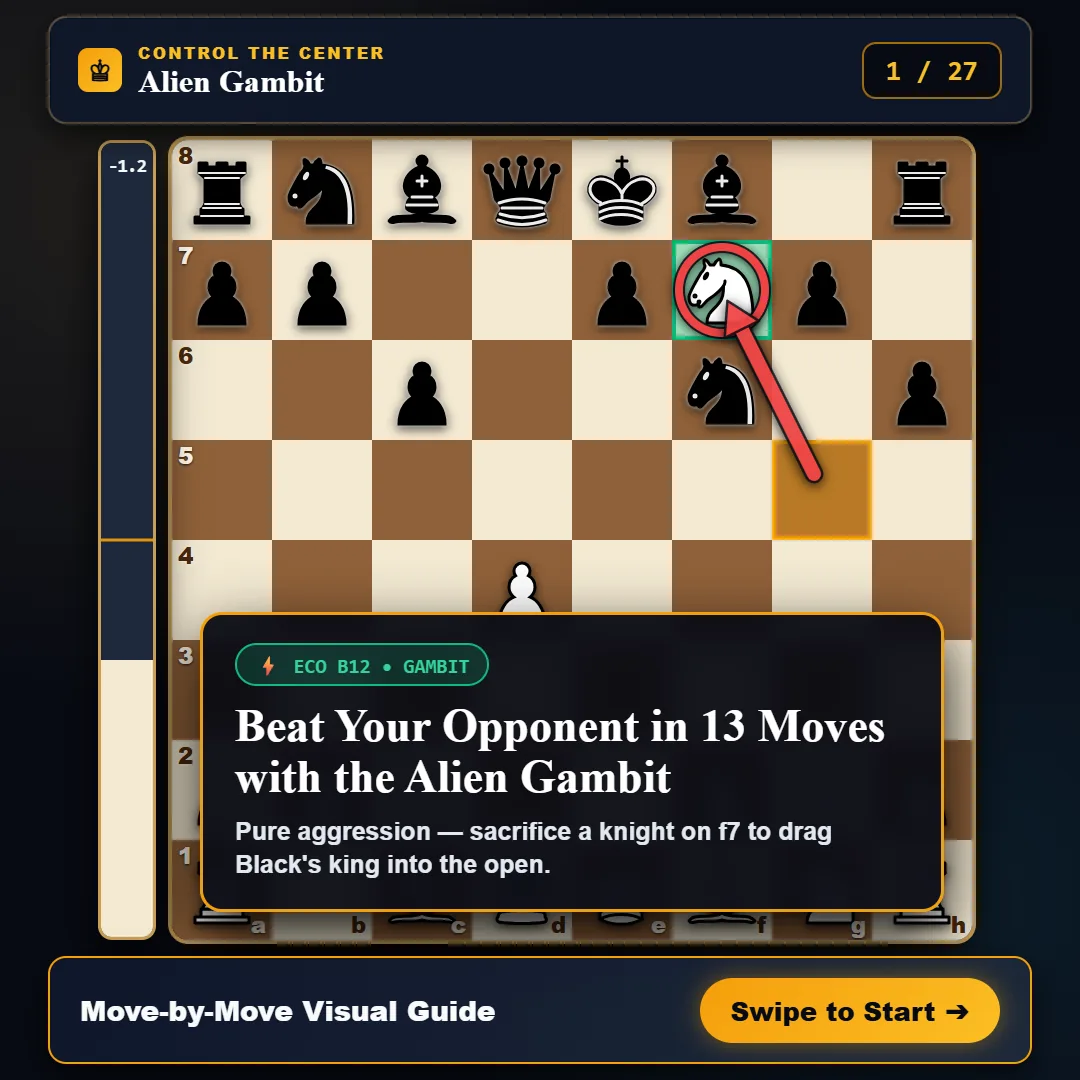
Alien Gambit chess opening visual guide — beat the Caro-Kann Defense in 13 moves (ECO B12)
Slide 1 / 27
⚡ Jump to Key Turning Points Click any card to inspect

💡 Tip: Use the ← Prev / Next → buttons (or swipe on mobile) to walk through all 27 slides on demand.


Sub-Variations, Move Orders & Transpositions

1. The Reflexive Blunder: 7.h3?!

Over 55% of club players reflexively play 7.h3 to kick the aggressive knight. This walks straight into the velvet trap:

  • 7...Ngxe5 8.Nxe5 Nxe5
  • 9.Bb5+ Bd7! 10.Qxd5 Bxb5
  • 11.Qxe5+ Be7! Stockfish evaluates this at -0.90 for Black. Black’s king remains safe on the kingside, while White’s king is pinned down in the center, facing unstoppable threats like ...Qd3 and ...Rd8.

2. The Solid Development Line: 7.Nbd2

White’s most resilient defense:

  • 7...Ngxe5 8.Nxe5 Nxe5
  • 9.Be2 Be7 10.O-O O-O Stockfish evaluates this at -0.31. Black has eliminated White’s strong d3 bishop, achieved total harmony, and holds easy dark-square pressure.

3. The Queen Defense: 7.Qe2

White tries to protect e5 with the queen:

  • 7...Ngxe5 8.Nxe5 Nxe5
  • 9.Bb5+ Bd7 10.O-O Bd6 Black possesses harmonious piece development, active bishop diagonals, and superior central space.

Win Rate & Stockfish 18 Evaluation

White ResponseFrequencyWhite Win %Draw %Black Win %Stockfish 18 Eval
7.h3?! (Reflex Blunder)56%19.8%12.4%67.8%-0.90 (Winning Black)
7.Nbd2 (Solid Line)28%33.5%28.5%38.0%-0.31 (Slight Black Edge)
7.Qe2 (Queen Defense)12%31.0%27.0%42.0%-0.35 (Slight Black Edge)
7.Bf4?! (Clumsy Defense)4%22.0%15.0%63.0%-1.15 (Decisive Black)

Practice & Interactive Tactical Puzzles

Exercise 1: Finding the Quiet Masterstroke

  • FEN: r2qkb1r/pp3ppp/8/1bp1Q3/8/2P1P2P/PP3PP1/RNB1K2R b KQkq - 0 11
  • Task: White just captured 11.Qxe5+. Find Black’s most powerful continuation.
  • Solution: 11...Be7!. Black calmly blocks the check. White’s queen is misplaced, White’s king is trapped on e1, and Black’s two bishops control the board with a crushing -0.90 advantage.

Black’s Attacking Arsenals & Tactical Motifs

  1. The Dark-Square Bishop Squeeze: Black’s light-squared bishop dominates the a6-f1 diagonal, permanently denying White kingside castling.
  2. The Open d-File Infiltration: Black’s queen and rooks rapidly take control of the open d-file to generate back-rank checkmate threats.
  3. Queen Swings to d3: If White greedily snatches pawns, ...Qd3 immediately sets up unstoppable checkmate nets.

White’s Defensive Blueprints & Counter-Measures

  1. Never play 7.h3: Kicking the knight loses the d3 bishop and opens fatal diagonals.
  2. Develop the Knight to d2: Playing 7.Nbd2 maintains control over e4 and allows White to trade knights peacefully.
  3. Prioritize King Safety: Castle kingside (O-O) at the earliest opportunity to avoid the center pin.

For experienced players

“The Colle System relies on slow, risk-free development. The Velvet-Trap Countergambit tears through that passivity on move five, turning a quiet Queen’s Pawn game into a dark-square attacking masterclass for Black.”

See also:Sacrifice·Decoy·Pin·Tempo·Controlling the center·Developing pieces

⚡ Tactical Trainer Free Interactive Practice

Master The Velvet-Trap Countergambit Tactics & Calculations

Drill opening traps, critical tactical forks, and king-hunt sacrifices with instant board evaluation and refutations.

Practice Tactics ➔
❓

Frequently Asked Questions (The Velvet-Trap Countergambit)

What is The Velvet-Trap Countergambit in the Colle System?

The Velvet-Trap Countergambit occurs when Black confronts the Colle System (1.d4 d5 2.Nf3 Nf6 3.e3 c5 4.c3 Nc6 5.Bd3) with 5...e5!? 6.dxe5 Ng4. Black offers the e-pawn to dismantle White's passive setup and secure dominant dark-square piece coordination.

Why is 7.h3 a mistake for White in The Velvet-Trap Countergambit?

Playing 7.h3?! looks natural but drops White into a severe positional bind: 7...Ngxe5 8.Nxe5 Nxe5 9.Bb5+ Bd7! 10.Qxd5 Bxb5 11.Qxe5+ Be7!. White grabs pawns but remains completely undeveloped and unable to castle, while Black's bishop pair and open d-file dominate (-0.90 eval).

How does Black compensate for the sacrificed pawn in this opening?

Black gains dynamic compensation through rapid piece development, possession of the bishop pair, an open d-file for the rooks, and constant pressure against White's backward central pawns.

What is White's best theoretical reply to 6...Ng4?

White should avoid 7.h3?! and instead develop quietly with 7.Nbd2 Ngxe5 8.Nxe5 Nxe5 9.Be2. This maintains balanced chances, though Black still enjoys free piece development and easy equality.

Famous Games

Colle System Autopilot vs Control The Center Gambit Lab

Winter Expansion Engine Verification, 2026

Black demonstrates the devastating power of the bishop pair against White's greedy queen in the 7.h3?! line, locking White's king in the center.

PGN Game Record for Colle System Autopilot vs Control The Center Gambit Lab
[Event "Winter Expansion Engine Verification"]
[Site "Control The Center Lab"]
[Date "2026.10.20"]
[White "Colle System Autopilot"]
[Black "Control The Center Gambit Lab"]
[Result "0-1"]
[ECO "D05"]

1. d4 d5 2. Nf3 Nf6 3. e3 c5 4. c3 Nc6 5. Bd3 e5 6. dxe5 Ng4 7. h3 Ngxe5 8. Nxe5 Nxe5 9. Bb5+ Bd7 10. Qxd5 Bxb5 11. Qxe5+ Be7 12. Qxg7 Qd3 13. Qxh8+ Kd7 14. c4 Bxc4 15. Nc3 Rxh8 0-1
♟️ Google Preferred Source

Follow The Velvet-Trap Countergambit & Opening Theory on Google

Add Control The Center as a preferred source on Google to see our interactive opening guides, Stockfish analysis, and tactical puzzles highlighted in Google Search.