






The Pawn in Chess
The foot soldier of chess. Pawns form the backbone of your position, control central squares, and can promote into queens upon reaching the 8th rank.
Physical Description & Anatomy
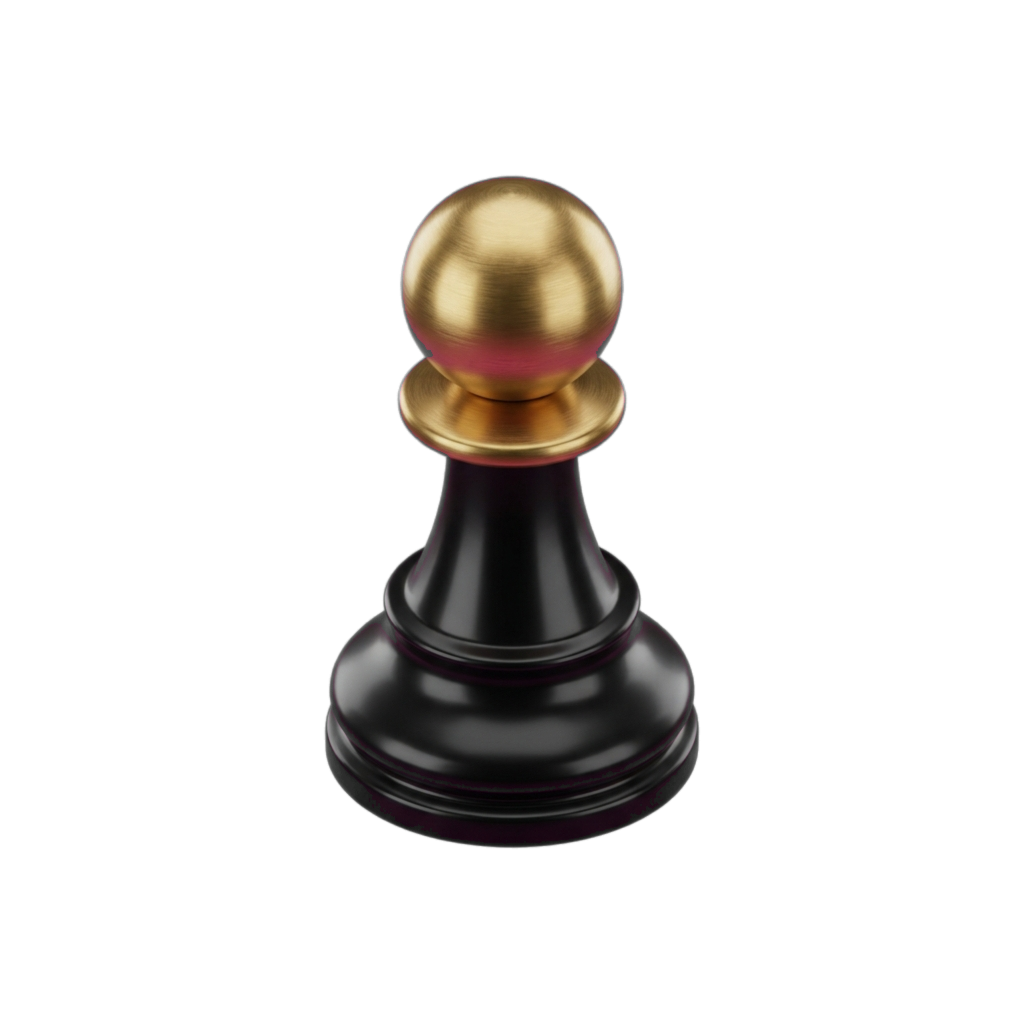
The shortest piece in the Staunton chess set. Characterized by a smooth, rounded spherical top sitting above a single slim collar ring and a weighted felt-padded pedestal base. In classic wood carving (like Boxwood and Sheesham), the pawn’s minimalist design reflects its humble status as the foot soldier of the board.
Movement Rules & Strategic Value
Moves forward one square at a time (or two squares on its first move). Captures diagonally forward one square. Captures en passant under special conditions.
As Philidor famously wrote, "Pawns are the soul of chess." They define the structure, create outposts for knights, restrict enemy pieces, and carry the ultimate threat of promotion.
All Pawns Casualty & Lifespan Analytics
In Master play, pieces survive ~26 plies longer due to prophylactic defense and endgame conversions.
Frequently Asked Questions (Pawn)
How does the pawn move in chess?
A pawn moves straight forward one square at a time, but captures diagonally forward one square. On its very first move, a pawn has the option to advance two squares forward.
Can a pawn move or capture backwards in chess?
No, pawns are the only piece in chess that can never move or capture backwards. They can only advance forward toward the opponent's 8th rank.
What happens when a pawn reaches the 8th rank?
When a pawn reaches the opposite end of the board (the 8th rank for White, 1st rank for Black), it immediately promotes into a Queen, Rook, Bishop, or Knight of the same color.
What is the en passant rule in chess?
En passant is a special pawn capture that occurs when an opponent advances a pawn two squares from its starting position, landing alongside your pawn. You can capture it diagonally as if it had only moved one square, but only on the very next move.
Individual Pawn Guides (16 Starting Pieces)
The white a-pawn starting on square a2. Defines a-file structures, coordinates with pieces, and supports dynamic central breaks in tactical chess games.
The white b-pawn starting on square b2. Defines b-file structures, coordinates with pieces, and supports dynamic central breaks in tactical chess games.
The white c-pawn starting on square c2. Defines c-file structures, coordinates with pieces, and supports dynamic central breaks in tactical chess games.
The foundation of classical positional play (1.d4). Supported by the d1 queen from move one, anchoring the Queen's Gambit, London System, and Catalan setups.
The single most popular opening move pawn in chess history (1.e4). Opens diagonals for the f1-bishop and queen while staking an immediate central claim.
The white f-pawn starting on square f2. Defines f-file structures, coordinates with pieces, and supports dynamic central breaks in tactical chess games.
The white g-pawn starting on square g2. Defines g-file structures, coordinates with pieces, and supports dynamic central breaks in tactical chess games.
The white h-pawn starting on square h2. Defines h-file structures, coordinates with pieces, and supports dynamic central breaks in tactical chess games.
The black a-pawn starting on square a7. Defines a-file structures, coordinates with pieces, and supports dynamic central breaks in tactical chess games.
The black b-pawn starting on square b7. Defines b-file structures, coordinates with pieces, and supports dynamic central breaks in tactical chess games.
The backbone of the Sicilian Defense (1...c5) and Caro-Kann Defense (1...c6), enabling dynamic central counter-attacks and opening crucial flank files.
The black d-pawn starting on square d7. Defines d-file structures, coordinates with pieces, and supports dynamic central breaks in tactical chess games.
Black's central king pawn. Playing ...e5 leads to classical Open Games; playing ...e6 builds solid French Defense structures and anchors central breaks.
The black f-pawn starting on square f7. Defines f-file structures, coordinates with pieces, and supports dynamic central breaks in tactical chess games.
The black g-pawn starting on square g7. Defines g-file structures, coordinates with pieces, and supports dynamic central breaks in tactical chess games.
The black h-pawn starting on square h7. Defines h-file structures, coordinates with pieces, and supports dynamic central breaks in tactical chess games.